
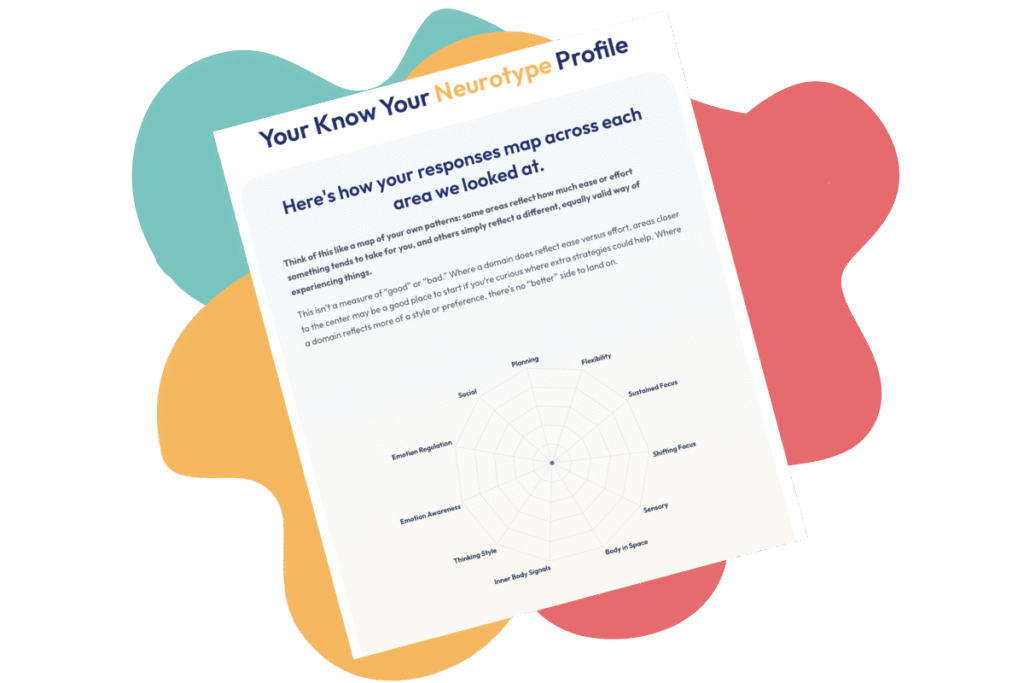
This overview gives you the big picture. Each area is thoroughly explained in your “deep dive” results further down this page.
Reading your results:
Thinking Style, Social, and Sensory work a little differently. These areas describe preferences rather than ease or effort, so your dot shows which way you lean, like noticing sensory input strongly or more lightly.
Hover over a category
Hover (or tap, on a touchscreen) any label around the chart to see what it measures.
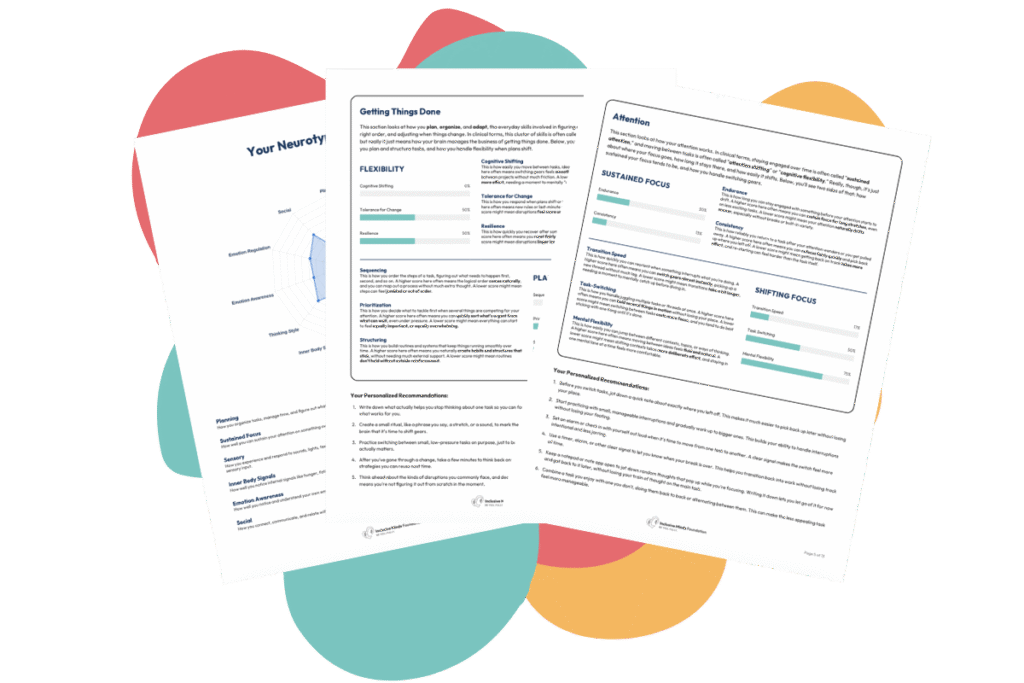
Buckle up, it’s a deep dive. Each section below breaks your score down by subdomain, so you can see exactly where your patterns show up. Jump around with the tabs, or save as a PDF to look back on this later.
This section looks at how you plan, organize, and adapt – the everyday skills involved in figuring out what to do, doing it in the right order, and adjusting when things change. In clinical terms, this cluster of skills is often called “executive functioning,” but really it just means how your brain manages the business of getting things done. Below, you’ll see two sides of that: how you plan and structure tasks, and how you handle flexibility when plans shift.
Flexibility
This is how easily you move between tasks, ideas, or ways of thinking. A higher score here often means switching gears feels smooth, or even energizing, letting you jump between projects without much friction. A lower score might mean transitions take more effort, needing a moment to mentally "close" one thing before starting the next.
This is how you respond when plans shift or the unexpected happens. A higher score here often means new rules or last-minute changes don't rattle you much. A lower score might mean disruptions feel more unsettling, especially without advance notice.
This is how quickly you recover after something knocks your day off track. A higher score here often means you reset fairly fast, without much residual stress. A lower score might mean disruptions linger longer than you'd like.
Did you know? Therapists trained in Cognitive Behavioral Therapy (CBT) and Acceptance and Commitment Therapy (ACT) often work with people on adapting to change. Both approaches focus on building more room to adjust when plans shift.
This is how you order the steps of a task, figuring out what needs to happen first, second, and so on. A higher score here often means the logical order comes naturally, and you can map out a process without much extra thought. A lower score might mean steps can feel jumbled or out of order.
This is how you decide what to tackle first when several things are competing for your attention. A higher score here often means you can quickly sort what's urgent from what can wait, even under pressure. A lower score might mean everything can start to feel equally important, or equally overwhelming.
This is how you build routines and systems that keep things running smoothly over time. A higher score here often means you naturally create habits and structures that stick, without needing much external support. A lower score might mean routines don't hold without outside reinforcement.
Planning
Did you know? Executive functioning coaches specialize in planning, organizing, and time management. They help people build systems that fit the way their brain naturally works.
This section looks at how you communicate, connect, and show up with the people around you – your natural style, what kind of settings feel most comfortable, how much you adjust yourself for others, and what kind of conversations you’re drawn to. In clinical terms, this is often called “social communication,” but really it’s just about how you relate to people, and there’s no one right way to do it.
This is how directly or indirectly you tend to communicate. A higher score here often means you lean literal and direct, saying exactly what you mean without much subtext. A lower score might mean your style leans more nuanced or indirect, reading between the lines and expecting others to as well.
This is whether you tend to gravitate toward one-on-one connection or group settings. A higher score here often means you tend to prefer or draw more energy from group settings. A lower score might mean you feel most comfortable and energized in one-on-one interactions .
This is how much you adjust or "mask" your natural self in social situations versus showing up as you are. A higher score here often means you tend to feel free to be fully yourself, without much adjusting. A lower score might mean you find yourself masking or adapting more often, especially in unfamiliar settings.
This is whether you're drawn more to surface-level exchanges or deeper conversations. A higher score here often means you tend to prefer deep, meaningful conversation over small talk. A lower score might mean you're more comfortable with lighter, surface-level exchange, at least at first.
Did you know? Neurodiversity-affirming therapists focus on supporting the way people naturally connect, not changing who they are. Speech-language pathologists and social skills groups also work on conversation and communication.
This section looks at how your attention works. In clinical terms, staying engaged over time is often called “sustained attention,” and moving between tasks is often called “attention shifting” or “cognitive flexibility.” Really, though, it’s just about where your focus goes, how long it stays there, and how easily it shifts. Below, you’ll see two sides of that: how sustained your focus tends to be, and how you handle switching gears.
Sustained Focus
This is how long you can stay engaged with something before your attention starts to drift. A higher score here often means you can sustain focus for long stretches, even on less exciting tasks. A lower score might mean your attention naturally drifts sooner, especially without breaks or built-in variety.
This is how reliably you return to a task after your attention wanders or you get pulled away. A higher score here often means you can refocus fairly quickly and pick back up where you left off. A lower score might mean getting back on track takes more effort, and re-starting can feel harder than the task itself.
This is how quickly you can reorient when something interrupts what you're doing. A higher score here often means you can switch gears almost instantly, picking up a new thread without much lag. A lower score might mean transitions take a bit longer, needing a moment to mentally catch up before diving in.
This is how you handle juggling multiple tasks or threads at once. A higher score here often means you can hold several things in motion without losing your place. A lower score might mean switching between tasks costs more focus, and you tend to do best sticking with one thing until it's done.
This is how easily you can jump between different contexts, topics, or ways of thinking. A higher score here often means moving between ideas feels fluid and natural. A lower score might mean shifting contexts takes more deliberate effort, and staying in one mental lane at a time feels more comfortable.
Shifting Focus
Did you know? Executive functioning coaches work with all kinds of attention styles. Occupational therapists also help people build routines that make transitions between tasks feel smoother.
Every sound, light, texture, and smell around you registers a little differently depending on your nervous system’s wiring. Some people pick up on details others miss, while others barely notice things that would overwhelm someone else. Sensory needs are also one of the easiest things to actually do something about: once you know your own patterns, small changes to your environment (dimmer lights, noise-canceling headphones, softer fabrics) can make a real difference. In clinical terms, this whole area is called “sensory processing,” but it really just comes down to how you take the world in.
Sensory
This is how you respond to light, brightness, movement, and visually busy environments. A higher score here often means visual input registers less strongly, and busier or brighter environments tend not to bother you as much. A lower score might mean you tend to be more sensitive to visual input, noticing flickering lights or clutter that others might not.
This is how you respond to sounds, volume, and background noise. A higher score here often means sound registers more faintly, and louder or noisier environments tend to not affect you much. A lower score might mean certain sounds can feel sharp or overwhelming, and you may notice subtle noises others miss.
This is how you respond to textures, touch, and physical sensations against your skin. A higher score here often means touch registers less strongly, and you may not notice textures that others find bothersome. A lower score might mean certain textures or touch can feel intense or irritating, like clothing tags or unexpected contact.
This is how you respond to smells and tastes. A higher score here often means smells and tastes register more faintly, and stronger scents or flavors tend not to bother you. A lower score might mean scents and flavors can feel strong or overwhelming, and you may pick up on smells others don't notice.
This is how you handle taking in more than one type of sensory input at the same time, like noise and light and touch all at once. A higher score here often means you can handle layered sensory input without it building up as much. A lower score might mean multiple sensory inputs together can feel quickly overwhelming.
Did you know? Occupational therapists trained in sensory integration focus on how people take in sound, light, texture, and other sensory input. They often help people build personal toolkits for busy or overwhelming environments.
This section looks at how connected you feel to your own body. It covers where your body is, how it moves, and whether you feel steady on your feet. In clinical terms, this is called “proprioception,” which is essentially your body’s internal GPS, letting you sense your position and movement without having to look.
Proprioception
This is how aware you are of where your body is in space, even without looking. A higher score here often means you tend to know exactly where your body is, moving through spaces with a strong sense of your own position. A lower score might mean that awareness registers less automatically, and you may bump into things or misjudge distances more often.
This is how your movements translate into precision, from reaching for something to more complex physical tasks. A higher score here often means movement tends to feel fluid and precise, with less conscious effort. A lower score might mean coordination takes more deliberate focus, and movements can feel clumsier or less exact.
This is your sense of balance, posture, and feeling physically steady. A higher score here often means you tend to feel naturally stable and grounded in your body. A lower score might mean steadiness takes more conscious effort, and certain movements like stretching or specific postures can help you feel more anchored.
Did you know? Occupational and physical therapists work with coordination, balance, and body awareness at any age. Vestibular therapy is a specialty focused specifically on dizziness and feeling steady.
This section looks at how you notice signals coming from inside your own body. In clinical terms, this is called “interoception.” It’s essentially the sense that lets you tell what’s happening inside you, the same way your other senses tell you what’s happening around you.
Interoception
This is how clearly you notice internal cues like hunger, thirst, fatigue, or temperature. A higher score here often means these signals tend to come through loud and clear, and you usually know what your body needs before it becomes urgent. A lower score might mean signals register more faintly, and you may not notice hunger or tiredness until it's fairly intense.
This is how much you notice the physical sensations tied to emotions, like a tight chest, a racing heart, or a knot in your stomach. A higher score here often means you tend to feel emotions in your body clearly, making it easier to connect a sensation to a feeling. A lower score might mean those physical cues register more subtly, and emotions can feel more like a mental experience than a physical one.
This is your ability to notice when you're becoming dysregulated, overwhelmed, or out of balance before it fully takes over. A higher score here often means you tend to catch the early signs and can respond before things escalate. A lower score might mean those early signals are harder to notice in the moment, and you may realize you're overwhelmed only once it's already intense.
Did you know? Noticing body signals like hunger, tiredness, and stress is a skill that can be practiced. Occupational therapists, somatic therapists, and mindfulness-based practitioners all work in this area.
This section looks at the different ways your mind processes information, makes connections, and finds structure (or doesn’t). In clinical terms, this area is often referred to as “cognitive style” or “thinking patterns,” but really it just describes the natural shape your thinking tends to take. None of these are better or worse ways to think.
Thinking Style
This is how much you lean toward structured, rule-based thinking versus more open-ended approaches. A higher score here often means you tend to think systematically and analytically, breaking things down into clear steps or categories. A lower score might mean your thinking leans more fluid and exploratory, without needing a fixed structure to work within.
This is how naturally your mind connects ideas that aren't obviously related. A higher score here often means you tend to make unexpected connections easily, jumping between ideas in ways that feel fresh or surprising. A lower score might mean your thinking stays more linear and direct, following a clearer, more predictable path from one idea to the next.
This is how much comfort and structure you find in routines, repetition, and predictability. A higher score here often means patterns and repetition feel steadying, giving your thinking a sense of order. A lower score might mean routine feels less necessary or even limiting, and you tend to feel comfortable without a fixed pattern to follow.
This is how often your thinking produces sudden leaps or "aha" realizations, versus building conclusions more gradually. A higher score here often means insight tends to arrive in sudden bursts, connecting dots in a flash. A lower score might mean understanding tends to build more gradually, piecing together conclusions step by step.
Did you know? Strengths-based coaches focus on helping people make the most of the way they naturally think. Psychological evaluations can also offer a fuller picture of how someone processes information.
This section looks at how you experience and move through your emotions once they show up, how intense they feel, how long they stick around, and how you tend to calm yourself when things feel like a lot. Clinically, this is called “emotion regulation,” and at its core, it’s about your own rhythm for feeling something and coming back down from it.
Emotion Awareness
This is how easily you can identify and put words to what you're feeling in the moment. A higher score here often means you tend to identify your feelings quickly, usually knowing what you're experiencing as it happens. A lower score might mean emotions can feel hard to pin down or name, even when you know something's there.
This is how much you naturally pick up on what someone else is feeling, even without feeling it yourself. A higher score here often means you tend to read others' emotions accurately, picking up on what's going on for them even when it's not stated outright. A lower score might mean other people's emotional states are harder to read or infer, especially without direct communication.
This is how much you feel other people's emotions alongside them, rather than just understanding them intellectually. A higher score might mean you can understand what someone's feeling without necessarily feeling it yourself. A lower score may mean you take on others' feelings as if they were your own, sometimes in ways that wear on you.
Did you know? Emotion-Focused Therapy (EFT) and Mentalization-Based Therapy (MBT) are designed around understanding and naming feelings. Dialectical Behavior Therapy (DBT) also teaches skills for noticing emotions as they happen.
This is how strong your emotions tend to feel once they show up. A higher score here often means emotions tend to stay more even-keeled, rarely spiking to an extreme. A lower score might mean emotions can arrive big and full-force, hard to ignore once they hit.
This is how long an emotion tends to stick around once it's triggered. A higher score here often means you tend to bounce back fairly quickly, with feelings passing through without lasting too long. A lower score might mean emotions can linger for a while, taking time to fully settle.
This is how you tend to calm yourself down once you're activated or overwhelmed. A higher score here often means self-soothing tends to happen more automatically, without needing to reach for a specific strategy. A lower score might mean you may lean on a wider range of coping tools, from stimming to movement to sensory input, to bring yourself back down.
This is how aware you are of how your emotions show up outwardly, through your face, voice, or body language. A higher score here often means you tend to notice how you're coming across to others in the moment. A lower score might mean your outward expression doesn't always match what's happening internally, even when the feeling is strong.
Emotion Regulation
Did you know? Dialectical Behavior Therapy (DBT) was built around practical skills for managing intense emotions. Eye Movement Desensitization and Reprocessing (EMDR) and Brainspotting are also used when past experiences shape how emotions show up today.
This section looks at how your mind handles doubt, uncertainty, and the pull to make things feel “right.” Everyone has an inner alarm, but some are set more sensitively than others. Think of a smoke detector that goes off when you’re just making toast. There’s no real fire, but the alarm is loud enough that it’s hard to ignore. It might go off over small things, like whether you locked the door, whether an email came across the wrong way, or a thought that popped into your head out of nowhere. Until it quiets down, it can be hard to rest. Clinically, the other end of this is called “intolerance of uncertainty,” and at its core, it’s about how much certainty your mind needs before it can settle. Below, you’ll see three sides of that: the thoughts that set the alarm off, what you do in your head to quiet it, and what you do out in the world to settle it.
Certainty Seeking
This is how easily uncertain or unwanted thoughts move through your mind. A higher score here often means passing thoughts come and go without much pull. A lower score might mean thoughts or worries hang on and feel urgent, sometimes even when part of you knows they don’t quite fit. We call these sticky thoughts. For a lot of people, that “sticky thought” feels like it’s protecting you and needs to “stick” around even when it is not needed.
This is how much mental work it takes to settle a worry. A higher score means you can let uncomfortable thoughts or doubts exist without analyzing or resolving them. A lower score means you tend to mentally review, reason, or repeat things until you feel reassured or certain.
This section measures how comfortable you are sitting with uncertainty. A higher score here often means you can move on once something is done. A lower score might mean you check, redo, or seek reassurance until something feels “just right.”
Did you know? Exposure and Response Prevention (ERP) is a therapy designed specifically for patterns of doubt, checking, and reassurance seeking. It works by gradually facing the situations that set off the alarm while practicing not doing the usual checking or reassuring. Over time, the brain learns that the alarm can quiet down on its own, and it starts going off less often.
We hope this neurotype exploration was useful for you. If you’re looking for more, the Expanded Report builds on everything above with:
Want to download a clean copy of everything above? Download a formatted PDF of this page for free.

Book a meeting with a licensed psychologist to walk through your results together and ask questions.

Ready to start working on something? Team up with a coach to build a plan and get moving.
Social